
In crisis? Call or text 988 any time, or dial 911 in an emergency.
Our services

Motivational Interviewing (MI)

Feeling two ways about change is normal. Motivational Interviewing is a respectful, collaborative conversation that helps you find your own reasons for change, without pressure, lectures or judgment.
What MI actually is

Your reasons. Your goals. Your pace.

Motivational Interviewing was developed by Drs. William Miller and Stephen Rollnick, first to help people with alcohol use. It is now used for many kinds of change, from substance use to taking medication, sleep, exercise and stress.
Rather than telling you what to do, your clinician helps you explore your mixed feelings, connect change to what you value and build confidence that change is possible. MI is often used on its own for a few sessions or blended with CBT and medication management.
The core model

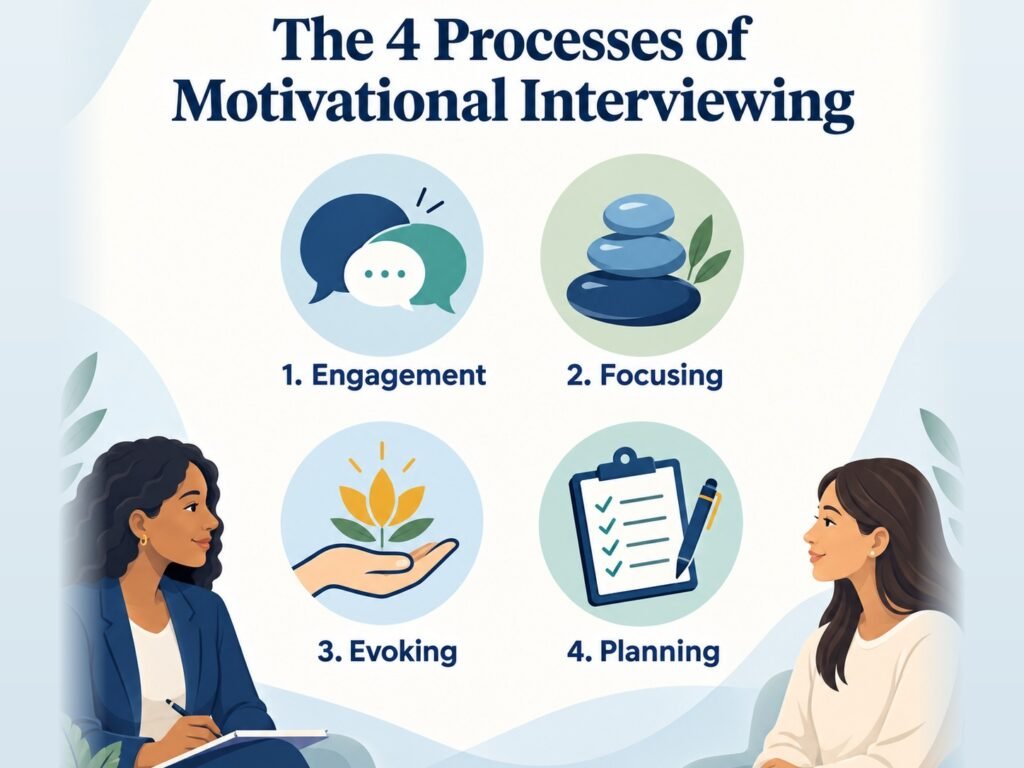
The four processes of Motivational Interviewing

These processes overlap and repeat as the conversation unfolds.

Engaging

Building a trusting, respectful working relationship where you feel heard.

Focusing

Agreeing on what to talk about and which change matters most to you right now.

Evoking

Drawing out your own reasons, hopes and ideas for change, in your own words.

Planning

When you are ready, turning your commitment into concrete, realistic next steps.
“People are more likely to change for their own reasons than for anyone else’s. MI helps you hear yours.”
Inside MI

What actually happens in a Motivational Interviewing session

01

Open questions

Questions that invite you to share your view, not just answer yes or no.
02

Affirmations

Recognizing your strengths, efforts and values along the way.
03

Reflective listening

Your clinician reflects back what they hear so you can see your own thinking more clearly.
04

Exploring both sides

We look honestly at what you like about the current situation and what concerns you.
05

Summaries

Pulling together your reasons for change so they feel clear and your own.
06

A plan you choose

If and when you are ready, you set goals and steps that fit your life.
What MI helps with

MI is effective whenever change feels hard

Substance use

Treatment engagement

Health habits

Behavioral

Life decisions

Paired with other care

Understanding the difference

MI vs. general talk therapy

Motivational Interviewing

General supportive talk therapy

Why Holy Family

What makes our MI care different

MI built around you

At Holy Family Mental Healthcare Services, Dr Loveline Awa, DNP, PMHNP-BC, and our team tailor every step of MI to your goals, pace and preferences.

Integrated psychiatry and therapy

Medication management and therapy are coordinated by one team, so your plan stays connected.

Care across the lifespan

We work with teens, adults and older adults, and involve families when it helps.

In person and telehealth

Visit our office in Sewell, NJ or meet by secure video from home.

Free consultation

Call (561) 285-1623 for a free consultation to talk through your needs and next steps.

Insurance-friendly

We accept most major insurance plans, including Medicare and Medicaid, and help you verify coverage.

Common questions

Common questions about MI

What if I am not sure I want to change?
That is exactly where MI starts. Feeling unsure is normal, and there is no pressure to commit to anything before you are ready.
No. MI is non-judgmental. Your clinician will share information if you want it, but decisions about your goals are yours.
MI can be helpful in as little as one to four sessions, and it is often blended into ongoing therapy or medication visits.
No. It started there, but MI is also used for medication adherence, sleep, health habits, gambling and other changes.
Yes. MI pairs especially well with CBT and medication management, and we often use them together.
Yes. MI conversations work well over secure video.
Ready to get started?

Change on your terms.

Wondering whether MI is the right fit for you? Call (561) 285-1623 to schedule a free consultation.
We provide compassionate, individualized mental health care designed to help you better understand yourself, manage emotional challenges, develop effective coping skills, and work toward meaningful personal goals. Every person has a unique story, and care should be tailored to your experiences, needs, strengths and goals.